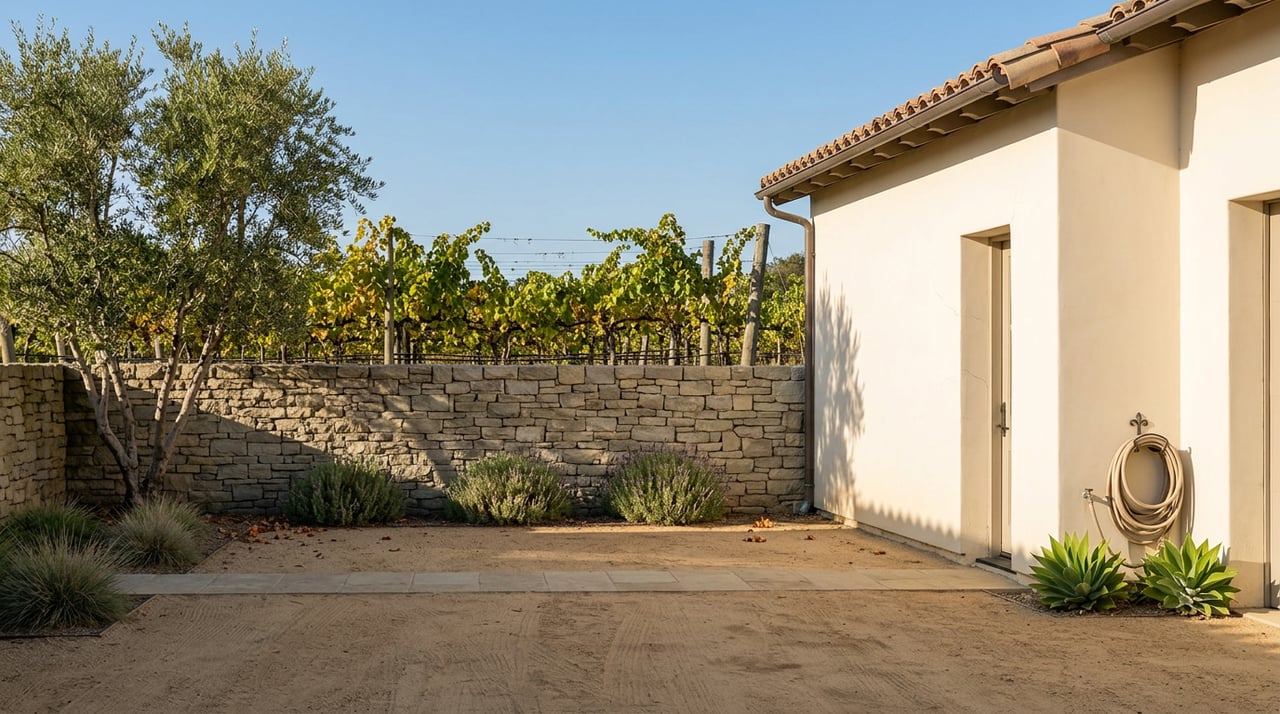
County planning documents draw one line around Temecula Wine Country and call it the Wine Country Policy Area. Inside that boundary, the zoning code treats a five-acre vineyard parcel on Rancho California Road the same way it treats a five-acre parcel two roads over. On paper, both can grow grapes, run a tasting room, host a wedding, or add a guest house under the same set of rules.
In practice, a different line is being drawn right now, and it does not match the zoning map at all. Eastern Municipal Water District is finishing a sewer project that only reaches certain roads and stops at specific cross streets. A parcel on the wrong side of that stop point keeps running on septic indefinitely, no matter what the zoning allows it to do. If you are buying, selling, or holding acreage in this area, that engineering boundary is quietly doing more to set your property's ceiling than any zoning designation on the deed.
A Decade Where Zoning Said Yes and Septic Said No
The county adopted its Wine Country Community Plan in 2014 with a clear goal: more wineries, more hotels, more restaurants, more of the agritourism economy that put Temecula on the map. Local winery counts had already climbed from roughly 18 to 34 over the prior decade, a doubling that put real pressure on wastewater systems built for a much smaller footprint. Riverside County's own account of the buildout is blunt about what happened after the plan passed: development stayed slow specifically because of a lack of infrastructure, and sewer was the piece that was missing.
Septic systems sized for a small tasting room in the 1990s were never built to handle a winery running weekend weddings, a full restaurant, and a steady stream of tour buses. Phil Baily, owner of Baily Winery and president of the Temecula Valley Winegrowers Association, put it plainly to Riverside County officials:
On any given weekend, our area is bursting at the seams with visitors attending events and tasting wine.
That volume is exactly what pushed septic capacity past its limit across parts of the district and is the direct reason EMWD is now installing miles of new sewer main through the heart of the valley.
The Two Alignments, and Where They Actually Stop
The current buildout is split into a Northern and a Southern alignment, and each one has a defined start and end point. That end point is the detail most buyers never think to ask about.
| Alignment | Roads served | Approximate length | Status as of August 2026 |
|---|---|---|---|
| Northern | Rancho California Road (Lomo Ventoso Lane to Buck Road), Glenoaks Road (Rancho California Road to Camino del Vino), Buck Road (Rancho California Road to Otis Street), Warren Road (Otis Street to East Benton Road), East Benton Road (Warren Road to Bella Vista Road) | About 14,467 linear feet, 2.74 miles | Under construction, targeted for completion by the end of 2026 |
| Southern | De Portola Road, from Butterfield Stage Road to Pulgas Creek Road | About 22,915 linear feet, 4.34 miles | The segment east of Butterfield Stage Road was on the city's schedule to wrap by May 2026, with the remainder of the alignment continuing toward the district's year-end target |
Notice where each alignment ends. The Northern line stops at Bella Vista Road. The Southern line stops at Pulgas Creek Road. Past those points, a parcel is still on septic, and there is no announced plan to extend service further at this time. Two vineyard properties that look identical on a map, same road, same general area, same zoning, can sit on opposite sides of that stop point and have entirely different practical futures.
What Ends Up on the Bill
EMWD board records price the full cost of bringing service to the Wine Country area at $28,844,000. Riverside County committed $5,000,000 toward that total, leaving $23,844,000 to be spread across the 4,383 equivalent dwelling units, commonly called EDUs, anticipated to develop in the service area over time. An EDU is simply the standard unit water and sewer agencies use to size and cost a connection, roughly equivalent to the wastewater flow of one single-family home, with a larger winery or event venue counting as multiple EDUs.
Additional grant funding softened the local share since that estimate was set. EMWD's own announcement of the project groundbreaking notes that the Northern and Southern alignments were funded in part through the American Rescue Plan Act, with $7.5 million allocated to the Northern alignment and $4.1 million to the Southern, plus a further $2 million in EPA State and Tribal Assistance Grants toward the Southern segment. That outside funding reduces what the district ultimately needs to recover from local connections, but the underlying mechanism, a per-EDU cost spread among the parcels the line actually reaches, is still how individual property owners in the benefit area experience the project financially.
This is not the district's first pass at this problem. EMWD completed an earlier phase of Northern Wine Country sewer service back in 2015 at a cost of $14.4 million, split between the county and a fund built by Wine Country property owners themselves. Property owners contributing directly to the infrastructure that services their own land has precedent here, and it is worth asking any seller whether that history includes assessments tied to the parcel you are considering.
Why This Changes What a Parcel Is Actually Worth
Here is the part that does not show up on a standard listing sheet. A vineyard parcel that fronts one of the served roads now has a realistic path to expanding a tasting room, adding event capacity, or increasing production without hitting a wastewater ceiling. A parcel just past Bella Vista Road or Pulgas Creek Road, otherwise identical on paper, is capped at whatever its existing septic system can support, and multiple sources describing this area agree that septic capacity has already been exceeded in parts of the district.
That means the sewer alignment map, not the zoning designation, is what actually separates a parcel with room to grow into a commercial wine country operation from one that will likely stay a private estate indefinitely. When you are comparing two properties with similar acreage and similar asking prices, the honest question is not just what the zoning permits. It is whether the parcel sits inside the served footprint or outside it.
Before writing an offer on any Wine Country acreage, a few things are worth confirming directly rather than taking on faith from a listing description:
- Check the parcel's actual road frontage against the specific served segments above, not just whether the listing says "Wine Country"
- Ask EMWD or your title company for the current EDU allocation and connection status tied to that APN
- If the parcel sits outside the alignment, request recent septic capacity records and pump test results, since capacity limits are the documented reason this project exists
- Ask whether the seller has already paid into, or still owes, any assessment tied to the sewer district
The Timeline If You're Buying or Selling This Year
With both alignments still targeted to wrap by the end of 2026, this is an active moment for due diligence rather than a settled fact you can assume from an older listing description. Segments already completed this year mean some parcels have gone from septic-only to sewer-eligible in the last few months alone. A seller whose parcel sits on the served side of the line has a genuine selling point worth documenting with the current construction schedule. A buyer looking at acreage near either endpoint should treat proximity to Bella Vista Road or Pulgas Creek Road as a real variable in the offer, not a footnote.
A Few Straight Answers
Does this only matter for working wineries, or does it affect residential-only Wine Country property too? It matters most directly for commercial capacity, but any large residential parcel considering a future guest house, ADU, or expanded septic system benefits from being on the served side of the line, since sewer access changes what future permitting looks like even for non-commercial additions.
Is connecting to the new line mandatory once it reaches a road? Availability does not automatically force a connection. Existing septic systems in good standing can typically continue operating, though any future expansion or new construction on a served parcel will likely need to tie in under current county and EMWD standards.
What if a parcel sits just outside the current boundary? There is no publicly announced extension beyond the current Northern and Southern endpoints at this time. A parcel just past Bella Vista Road or Pulgas Creek Road should be evaluated on the assumption that septic will remain its only option for the foreseeable future.
Wine Country acreage is one of the few corners of Southwest Riverside County where the real financial story sits underneath the listing photos rather than in them. If you are weighing a Wine Country purchase or thinking about what your own parcel's position on this map means for a future sale, Temecula Valley Homes can walk through the specific alignment status for your address and what it means for value. Request a Free Home Valuation to start that conversation with real numbers behind it.